

Office tenants approaching lease expiration face a fundamentally different market than they did a decade ago. This update reflects two critical shifts reshaping tenant strategy: (1) the conversion of office buildings for alternative uses, e.g., residential, data center, etc.; and (2) the shortage of quality, top tier space as new office development has ground to a halt.
- With the growing trend of office buildings in Chicago and nationally being repurposed for alternative uses, renewal rights (once an academic right in soft office markets) have taken on renewed importance for tenants today. For tenants considering renewal, a renewal right gives them a strategic advantage as it provides an insurance policy to avoid the disruption and cost of a move. It will also create leverage for tenants to negotiate for concessions that will defer move costs in the event the landlord decides to redevelop the building.
- As tenants vie for limited premium office space, renewal rights provide tenants with some security against the disruption and expense of moving not to mention potentially higher rents.
Most tenants do not appreciate that lease renewals remain one of the most profitable leasing transactions for landlords. As most tenants look to renew their lease to avoid the disruption associated with a relocation and as landlords perceive existing tenants as a “captive audience”, I’ve outlined below 10 steps for tenants to employ so as not to leave money on the table based upon my 25+ years representing office tenants in Chicago and throughout the country.
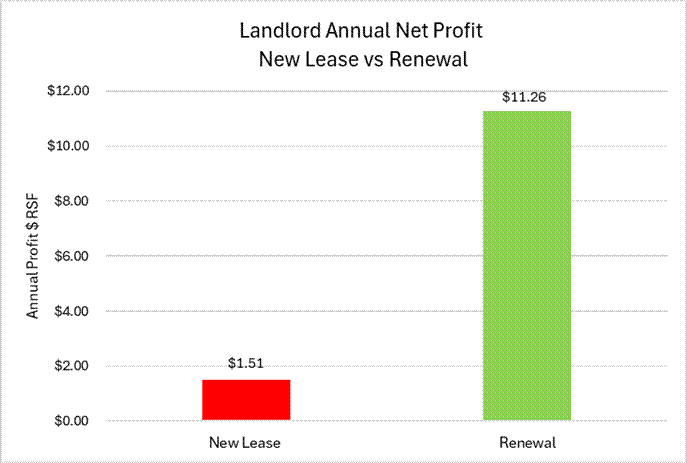
The Landlord’s $ Perspective. Before I discuss strategies, tenants should first understand the financial impact to landlords of new leases and lease renewals. As illustrated below, new leases often represent a marginal profit (or even a loss) for landlords given the higher transaction costs (larger construction allowances, more concessions and downtime). Landlords are willing to take a loss with the hope of making it up on renewal, as 70% of tenants renew their lease. Landlords know tenants want to avoid the disruption and cost of a move. As a result, they perceive existing tenants as a captive audience.
Below is a simple financial comparison of the net profit for a new lease and renewal from the landlord’s perspective:
A 10-Step Strategy for Lease Renewal Leverage
Step 1 – Hire a Tenant Representative. At the risk of sounding self-serving, tenants are well advised to retain a tenant representative to represent their interests for the following reasons:
- Levels the Playing Field – Your landlord negotiates leases daily and with the entire leasing process tilted to favor landlords, most tenants need an advocate who will stand toe-to-toe with the landlord, being knowledgeable of market conditions and leasing issues.
- Make Your Landlord Compete for Your Tenancy – The mere act of engaging a tenant rep sends the message to your landlord that they will need to be competitive and that you’re seriously exploring options. Conversely, an unrepresented tenant signals to the landlord that they are not seriously thinking of moving; hence, the landlord does not have to be competitive.
- Buffer is Created – Your tenant rep will provide a buffer between you and the landlord, which is important as (i) the majority of the time you would be dealing with the landlord’s agent, not the landlord directly; and (ii) it allows your tenant rep to be the “bad guy” and you to preserve a positive relationship with your landlord.
- You are Already Paying their Fee – A market commission is embedded into the economic terms of the lease and will be the compensation to your tenant representative. Not hiring a tenant rep usually means that the landlord or its agent will keep the entire commission.
- Saves Internal Resources – A good tenant rep will save you considerable time and money so that you can focus on your core business.
Step 2 – Review Lease & Create Timeline. Carefully review your lease and any renewal rights. There may be lease provisions that you wish to revisit with your landlord, e.g., security deposit, operating expense treatment, relocation rights, expansion rights, etc. There may also be provisions in your lease that can prove to be valuable bargaining chips that you can “horse trade” with the landlord for favorable terms, e.g., waiving an expansion option that would allow the landlord to accommodate a growing neighboring tenant or allow the landlord to redevelop the building to an alternative use.
Most renewal provisions will require notice from 6 to 12 months in advance of lease expiration. In a tight market and in a building that is well occupied or where a building is a target for conversion, a renewal right may be more than academic. If structured properly, it gives the tenant leverage. Typically, the terms for renewal are based upon “market terms” and there may be a defined mechanism to determine “market terms”.
Time is the most precious asset in any negotiation and that’s particularly the case in office leasing, given the long lead times involved. Practically speaking and from a timing perspective, tenants should approach renewal as if they are going to relocate while also keeping in mind when they need to issue a notice of renewal. For most tenants I advise looking at least 12 months in advance of lease expiration and will need to be extended to account for issuing a notice of renewal. For example, if the Tenant is required to issue a notice of renewal 12 months in advance, then the Tenant should start the process 18 months in advance. Additionally, in the event you identify a relocation option involving construction of a new building (the new construction cranes will return) the timeline will need to be extended further, i.e., 24+ months.
Step 3 – Assess Space, Location & Building Needs. As most tenants facing renewal are nearing the end of a lease that was negotiated 5 or more years prior, their space needs as well as how they work have likely changed considerably particularly in the post-COVID world where employers are looking to create a commute-worthy workplace. Business changes rapidly, which is one of the major challenges in leasing office space as leases are typically long-term commitments.
- Space Programming – Tenants should have their tenant rep complete a space program. This is a valuable exercise to recalibrate how much space you need now and, if your crystal ball is working, over the next 3 – 5 years. With a more mobile workforce and alternative workplace arrangements, many tenants realize that they have more space than needed. It is not uncommon to see tenants with 20% or more space than necessary.
- Location Assessment – Does the location support your business? As was the trend pre-COVID, many suburban based tenants who are seeking younger talent look to urban office locations.
- Building Assessment – Are there any issues with your space, building and/or property management? What is the building’s debt status? What improvements and amenities are being planned? Be sure to survey your employees as there may be issues you are unaware of. If so, these can be addressed in your renewal discussions with your landlord.
- Improvements to Space if Renewing – Define what you would want to change in your space.
This space assessment will provide you with valuable information before you approach your landlord. The key to successfully negotiating a renewal is to have a credible basis for relocation and the information gained from this exercise will provide you with that basis. For example, if you have 20% more space than needed, then your landlord is at a competitive disadvantage which they will try to make up for to your benefit.
Step 4 – Survey the Market. With the project timeline in mind and based on information gleaned from the assessment, your tenant rep should thoroughly research the market to identify potential relocation options. You may be pleasantly surprised at what’s out there. For example, here in Chicago (and many other major markets) there has been an “amenities arms race” among buildings. Many buildings are taking full floors out of their leasing to create amenity floors with extensive conference facilities, break areas, fitness centers (rivaling top health clubs) as well as outdoor spaces. Beyond the new bells and whistles, you may be surprised by the economics being offered. So, don’t cut any corners by merely looking at the latest quarterly office market statistics. The office market is very dynamic.
Step 5 – Look Under Current Building’s Hood. Your landlord is probably not the same landlord that you entered into your lease with 5 or more years ago, given the dramatic drop in building valuations and debt issues. While tenants cannot control who their landlord will be, they hopefully negotiated a favorable lease with safeguards in place. Tenants should have their tenant rep do some homework on your current landlord as to debt structure, loan maturity dates, tenant rollover and expansions. Knowledge is power in negotiations. A well-informed tenant can use this knowledge to their advantage in negotiations.
Step 6 – Hit the Street. Before engaging your landlord in negotiations, you should tour potential relocation buildings with your tenant rep. As the local real estate market is a very close-knit community where word travels fast, the fact that you are touring options will quickly get back to your landlord. Perception is reality.
Step 7 – Auction Your Tenancy. Key to successful leasing is competition. You must have your landlord compete for your tenancy against other landlords in the market. Tenants are often under the mistaken impression that if they have been a long-time tenant, they are entitled to a special deal. There is no “favored nation” status.
After your tour and having narrowed the pool of options, your tenant rep should craft a Request for Proposal (RFP) to address key business and lease issues for your relocation options. At the same time, an RFP should be crafted for your current landlord to address these same issues (including those raised in the assessment phase). Your current landlord has one advantage that the relocation options do not: reducing your remaining lease obligation. That is a point you should raise in the RFP by requesting a reduction in the remaining lease obligation.
Be careful in your renewal RFP not to trigger any renewal notices under the lease with the appropriate disclaimers. Also, by issuing an RFP you are asking that the landlord make the first move. It’s a losing game to make the first offer.
Step 8 – Crunch the Numbers. Once you have responses from the RFP, your tenant rep should provide a financial analysis of the renewal and relocation options on an “apples to apples” basis by taking into account relocation costs as well as any reduction in the remaining lease obligation. If your footprint has decreased by 20% and after accounting for relocation costs, you may find that relocation is more cost effective. Keep in mind that your landlord is savvy. They know how much it costs to relocate. Hopefully, you did not make any recent improvements to your space or equipment investments that would embolden the landlord into thinking that you do not want to walk away from that recent investment. For added perspective, your tenant rep should also create a landlord analysis of the renewal and new deals scenarios. This will help in formulating counterproposals.
Step 9 – Counterproposals & Space Planning. Building on the issues with the current building, you should issue counterproposals to your current landlord and select relocation options. Also, engage in space planning of the current building and/or relocation options.
Step 10 – Issuing Notice & LOI & Lease. Important update: If you are renewing in a building that is poised for conversion, be prepared to issue a formal notice of renewal per your lease and related notice provisions. Carefully review your lease with your attorney as your incumbent landlord will look for any reason to nullify your option to renew. Keep in mind that the renewal language will likely prescribe its own process of arriving at renewal terms and pay close attention to those terms. For future leases, please see our post on a check list of issues to consider in negotiating a renewal option: The Option to Extend: Leverage in a Soft Market, Protection in a Tight Market – Blackacre Advisors LLC
After you select your relocation option or decide to renew where there is no formal renewal right (or it’s not at issue), you should negotiate a Letter of Intent to elaborate on the proposal negotiations and lay the groundwork for the lease. See my post on effectively negotiating Letters of Intent. If you don’t want to lose your great view, can you eliminate or limit the landlord’s right to relocate you? See my post on Relocation Rights. Assume 4 weeks to negotiate the lease and/or amendment.

Don Wenig
Blackacre Advisors LLC
info@blackacreadvisors.com
312-345-4778
DISCLAIMER. Our writings are from a real estate transaction perspective and for informational purposes only. Nothing herein shall be considered legal, accounting, tax, or architectural advice. Please consult with the appropriate professional(s).
0 comments on “Tenant’s Lease Renewal Strategies – 2026 Update” Add yours →